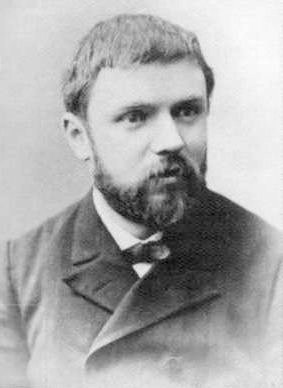
I gave on Friday November 13 2026 a mini-course on Poincaré inequalities for gases, including G$\beta$E and the Complex Ginibre Ensemble, at the Institut Henri Poincaré 🙂 for the MEGA seminar. An eight-page PDF of lecture notes is available, see [IHP] below. This post is devoted to a proof of the optimal Poincaré inequality for the complex Ginibre log-gas, after [C], see also [R] and [S]. Henri Poincaré introduced the inequalities bearing his name in [P] published in 1890, for his study of partial differential equations.
The Boltzmann-Gibbs measure. Let $M$ be an $n\times n$ random matrix with iid complex Gaussian entries of mean $0$ and variance $1/n$. Its density on $\mathcal{M}_{n\times n}(\mathbb{C})$ is $\propto\mathrm{e}^{-n\mathrm{Tr}(MM^*)}$. Let $\mu_n$ be the joint distribution of the eigenvalues of $M$. Following Ginibre in [G], \[ \mathrm{d}\mu_n(z) =\frac{\mathrm{e}^{-n\sum_{k=1}^n|z_k|^2}}{c_n}\prod_{j < k}|z_j-z_k|^2\mathrm{d}z =\frac{|V_n(z)|^2}{c_n'}\mathrm{d}\gamma_n(z), \quad V_n(z)=\prod_{j < k}(z_k-z_j), \] where $\gamma_n=\mathcal{N}_{\mathbb{C}}(0,\frac{1}{n}I_n)\propto\mathrm{e}^{-n|z|^2}\mathrm{d}z$ on $\mathbb{C}^n=\mathbb{R}^{2n}$ and $c_n'=\int|V_n|^2\mathrm{d}\gamma_n$. This is \[ \mu_n\propto\mathrm{e}^{-E}, \quad\text{with}\quad E(z)=n|z|^2+\Phi(z), \quad\Phi(z)=2\sum_{j < k}\log\frac{1}{|z_j-z_k|}. \]
- For $n\geq2$, since $\log\frac{1}{\left|\cdot\right|}$ on $\mathbb{R}^2$ has Hessian eigenvalues $\pm\left|\cdot\right|^{-2}$, $E$ is not convex and the Bakry–Émery curvature is $-\infty$. In contrast with the Gaussian Unitary Ensemble, we cannot recover convexity by reordering the coordinates. Moreover $\log\frac{1}{\left|\cdot\right|}$ is harmonic on $\mathbb{C}\setminus\{0\}$ and superharmonic on $\mathbb{C}$ in the distributional sense since $\Delta\log\left|\cdot\right|=2\pi\delta_0$, instead of being sub-harmonic, the trace weakening of convexity. The proof below uses holomorphy, which beats convexity in some sense.
- The measure $\mu_n$ is reversible for a planar Coulomb overdamped Langevin dynamics with generator $L/n$, where \begin{align*} L&=\Delta-\nabla E\cdot\nabla\\ &=4\sum_{i=1}^n\partial_{z_i}\partial_{\bar z_i} -2\sum_{i=1}^n\Bigl[ \Bigl(nz_i-\sum_{j\ne i}\frac{1}{\bar z_i-\bar z_j}\Bigr) \partial_{\bar z_i} +\Bigl(n\bar z_i-\sum_{j\ne i}\frac{1}{z_i-z_j}\Bigr) \partial_{z_i} \Bigr]. \end{align*} For $n\geq2$, this is not the Dyson eigenvalue process of the complex matrix Ornstein-Uhlenbeck diffusion: its eigenvalue quadratic variations involve eigenvector overlaps [BD]. This is due to the fact that the matrices from the complex Ginibre ensemble are not normal, in contrast with the Hermitian matrices from the Gaussian Unitary Ensemble. For the same reason, the Poincaré inequality for $\mu_n$ cannot be transferred directly from the Gaussian matrix law by the usual Lipschitz argument: the spectrum is not a Lipschitz function of the entries.
- Since $\Phi(z+u)=\Phi(z)$ for all $z$ and all $u\in F=\mathbb{C}(1,\ldots,1)$, the log-gas $\mu_n$ admits a splitting with a Gaussian factor. Namely it is the image by $(x,y)\mapsto x(1,\ldots,1)/\sqrt n+y$ of the product measure \[ \mathcal{N}_{\mathbb{C}}\Bigl(0,\frac{1}{n}\Bigr)\otimes\nu_n \] where $\nu_n$ is the probability measure on $F^\perp$ with density $\propto\mathrm{e}^{-E(y)}$. In other words, the center-of-mass is Gaussian and independent of the recentered gas. For $n\geq2$, however, the recentered factor $\nu_n$ is not log-concave, in contrast with the case of the Gaussian Unitary Ensemble. This splitting for the complex Ginibre log-gas was already observed by Robert B. Laughlin in the 1980s in his famous study of the fractional quantum Hall effect, see [L], see also [CL].
The Poincaré inequality. For all $n\geq1$ and all symmetric and real-valued $f\in H^1(\mu_n)$, \[ \operatorname{Var}_{\mu_n}(f)\leq\frac{1}{2}\mathcal{E}_{\mu_n}(f,f), \] where $H^1(\mu_n)$ is the closure of $\mathcal{C}^\infty_c(\mathbb{C}^n)$ with respect to the weighted Sobolev norm, and \[ \operatorname{Var}_{\mu_n}(f) =\int f^2\mathrm{d}\mu_n-\Bigl(\int f\mathrm{d}\mu_n\Bigr)^2 \quad\text{and}\quad \mathcal{E}_{\mu_n}(f,f) =\frac{1}{n}\int_{\mathbb{C}^n}|\nabla f|^2\mathrm{d}\mu_n. \] Moreover, equality is achieved if and only if $f$ is a center-of-mass observable: \[ f=\Re(aS)+b,\quad a\in\mathbb{C}, b\in\mathbb{R}, S=z_1+\cdots+z_n. \] In other words the constant $1/2$ is optimal and the optimal functions are explicit. The symmetry assumption is essential, see the comments below.
A proof. We start with the Poincaré inequality, and then we consider its optimality. Symmetrization and a smooth symmetric correction of the mean reduce the proof to centered, real, symmetric $f\in\mathcal{C}^\infty_c$. All the $L^2$ spaces that are used are complex. The proof has several steps and involves the following crucial properties:
- the test function $f$ is symmetric and real
- the Vandermonde $V_n$ is antisymmetric and holomorphic
- every entire antisymmetric function is divisible by $V_n$.
Vandermonde transform. Let us denote $z_k=x_k+\mathrm{i}y_k$ and \[ \partial_k=\frac12(\partial_{x_k}-\mathrm{i}\partial_{y_k}), \quad \bar\partial_k=\frac12(\partial_{x_k}+\mathrm{i}\partial_{y_k}). \] Since $V_n$ is holomorphic, for real-valued $f$, $|\nabla f|^2=4\sum_k|\bar\partial_kf|^2$, and thus \[ \int|\nabla f|^2\mathrm{d}\mu_n =\frac{4}{c_n’}\sum_{k=1}^n\|\bar\partial_k(V_nf)\|_{L^2(\gamma_n)}^2. \] This transforms $\mu_n$ into $\gamma_n$. Actually since $f$ is symmetric, the map $U:f\mapsto V_nf/\sqrt{c_n’}$ is a unitary map from $L^2_{\mathrm{sym}}(\mu_n)$ onto $L^2_{\mathrm{anti}}(\gamma_n)$. In the mathematical physics jargon, this is a ground state transform, with respect to a holomorphic weight.
Hörmander-Berndtsson estimate. Let $\mathcal{F}_n$ be the space of entire functions in $L^2(\gamma_n)$, known in complex analysis and in mathematical physics as the Bargmann-Fock space. Then, the Hörmander-Berndtsson estimate says that for all $g\in\mathcal{C}^\infty_c(\mathbb{C}^n,\mathbb{C})$, \[ \sum_{k=1}^n\|\bar\partial_kg\|_{L^2(\gamma_n)}^2 \geq n\operatorname{dist}_{L^2(\gamma_n)}(g,\mathcal{F}_n)^2. \] Both sides measure a lack of holomorphy of $g$. This is the analogue of a Poincaré inequality for $\gamma_n$, where this time the kernel of $\bar\partial$ is formed by square integrable holomorphic functions instead of the constants. An elementary proof relies on the complex Hermite orthogonal polynomials, which are orthogonal with respect to $\gamma_n$. This mimics the Hermite proof of the standard Poincaré inequality for $\gamma_n$.
More precisely, an integration by parts gives that the adjoint of $a_k=\bar\partial_k$ in $L^2(\gamma_n)$ is $a_k^*=-\partial_k+n\bar z_k$, and $[a_j,a_k^*]=n\delta_{jk}$, $[a_j,a_k]=0$. Let $H_{p,q}=\prod_k(a_k^*)^{q_k}z_k^{p_k}$, $p,q\in\mathbb{N}^n$ (complex Hermite polynomials). Since $a_kz^p=0$, the commutation relations give \[ a_k^*a_kH_{p,q}=nq_kH_{p,q} \quad\text{and}\quad \|a_k^*H_{p,q}\|^2=n(q_k+1)\|H_{p,q}\|^2. \] The $H_{p,q}$ are products of one-variable functions, and in one variable $H_{p,q}$ is an eigenfunction of $a^*a$ with eigenvalue $nq$ and has weight $\mathrm{e}^{\mathrm{i}(p-q)\theta}$ under the rotation $z\mapsto\mathrm{e}^{\mathrm{i}\theta}z$, which preserves each factor of $\gamma_n$. Since $(p-q,q)$ determines $(p,q)$, the $H_{p,q}$ are orthogonal. Moreover $H_{p,q}$ equals $n^{|q|}z^p\bar z^q$ plus terms of lower total degree, so they span $\mathbb{C}[z,\bar z]$, which is dense in $L^2(\gamma_n)$. Thus $\hat H_{p,q}=H_{p,q}/\|H_{p,q}\|$ is an orthonormal basis, and $\mathcal{F}_n$ is the closed span of $\hat H_{p,0}$. With $c_{p,q}=\langle g,\hat H_{p,q}\rangle$, we get \[ \langle a_kg,\hat H_{p,q}\rangle=\langle g,a_k^*\hat H_{p,q}\rangle=\sqrt{n(q_k+1)}c_{p,q+e_k}, \] and by Parseval \[ \sum_{k=1}^n\|a_kg\|^2 =\sum_{p,q}n|q||c_{p,q}|^2 \geq n\sum_{p,\,q\neq0}|c_{p,q}|^2 =n\|g-\mathrm{proj}_{\mathcal{F}_n}g\|^2. \] This completes the proof of the Hörmander-Berndtsson estimate. For $g=V_nf$ it gives \[ \int|\nabla f|^2\mathrm{d}\mu_n \geq\frac{4n}{c_n’}\operatorname{dist}_{L^2(\gamma_n)}(V_nf,\mathcal{F}_n)^2. \]
Divisibility. Set $H=\mathrm{proj}_{\mathcal{F}_n}(V_nf)$. Since $f$ is symmetric, $V_nf$ is antisymmetric. Since the projection commutes with permutations, $H$ is antisymmetric. By divisibility (as in the Weierstrass theorem), we have $H=V_nh$ for an entire symmetric $h$, and \[ \mathcal{F}^{\mathrm{div}}_n=\{h\text{ entire symmetric}:V_nh\in\mathcal{F}_n\} =U^{-1}(\mathcal{F}_n\cap L^2_{\mathrm{anti}}(\gamma_n))\subset L^2(\mu_n) \] is a closed subspace containing the constants. By isometry, $h=\mathrm{proj}_{\mathcal{F}^{\mathrm{div}}_n}(f)$, and \[ \operatorname{dist}_{L^2(\gamma_n)}(V_nf,\mathcal{F}_n)^2 =\|V_nf-V_nh\|_{L^2(\gamma_n)}^2 =c_n’\|f-h\|_{L^2(\mu_n)}^2 =c_n’\operatorname{dist}_{L^2(\mu_n)}(f,\mathcal{F}^{\mathrm{div}}_n)^2. \]
Rotation. Rotations $z\mapsto\mathrm{e}^{\mathrm{i}\theta}z$ preserve $\mu_n$ and $\mathcal{F}^{\mathrm{div}}_n$, hence commute with the projection. Let us write the Taylor series of $h$ as $h(z)=\sum_{m\geq0}h_m(z)$, where $h_m$ is homogeneous of degree $m$. The degree-zero term is the projection of $f$ onto the constants, so it vanishes since $\int f\mathrm{d}\mu_n=0$. Since $\langle h,\bar h\rangle=\int h^2\,\mathrm{d}\mu_n$, rotational invariance lets us average this integral over rotations. For each fixed $z$, the angular average of $h(\mathrm{e}^{\mathrm{i}\theta}z)^2$ is zero, in other words its Taylor series has no constant term. The Fubini theorem applies since the rotational average of $|h(\mathrm{e}^{\mathrm{i}\theta}z)|^2$ integrates to $\|h\|_{L^2(\mu_n)}^2$. Thus $h\perp\bar h$. The projection identity gives $f-h\perp h$ in $L^2(\mu_n)$. Since $f$ is real-valued, we get $\bar{f}=f$, so conjugating this identity gives $f-\bar h\perp\bar h$. Together with $h\perp\bar h$, these identities yield $r:=f-h-\bar h\perp h$ and $r\perp\bar h$, and therefore, denoting $\left\|\cdot\right\|=\left\|\cdot\right\|_{L^2(\mu_n)}$, \[ \operatorname{dist}(f,\mathcal{F}^{\mathrm{div}}_n)^2 =\|f-h\|^2=\|h\|^2+\|r\|^2 =\frac{\|f\|^2+\|r\|^2}{2} \geq\frac{1}{2}\|f\|^2. \] This completes the proof of the Poincaré inequality. Summarizing, \[ \int|\nabla f|^2\mathrm{d}\mu_n \geq4n\operatorname{dist}_{L^2(\mu_n)}(f,\mathcal{F}^{\mathrm{div}}_n)^2 \geq2n\|f\|_{L^2(\mu_n)}^2 =2n\operatorname{Var}_{\mu_n}(f). \]
Optimality. Since $\Phi$ is invariant along $F=\mathbb{C}(1,\ldots,1)$, the splitting gives $S\sim\mathcal{N}_{\mathbb{C}}(0,1)$, independent of $z-\frac{S}{n}(1,\ldots,1)$. Hence $\operatorname{Var}_{\mu_n}(\Re(aS))=\frac{|a|^2}{2}=\frac{1}{2n}|\nabla\Re(aS)|^2$ proving optimality. The closedness of the Gaussian $\bar\partial$ form allows us to extend the Hörmander-Berndtsson estimate to $g=V_nf$ with $f\in H^1(\mu_n)$, leading to a sum-of-squares formula for the deficit: for all symmetric centered real $f\in H^1(\mu_n)$, \[ \int|\nabla f|^2\mathrm{d}\mu_n-2n\operatorname{Var}_{\mu_n}(f) =2n\|r\|^2+4n\sum_{m\geq2}(m-1)\|g_m\|^2_{L^2(\gamma_n)}, \] where $g_m$ is the orthogonal projection of $Uf$ on the closed span of the complex Hermite polynomials $H_{p,q}$ with $|q|=m$, namely the eigenspace of $\sum_ka_k^*a_k$ for the eigenvalue $nm$ (and not the part of degree $m$ in $\bar z$, since $H_{p,q}$ contains lower order terms $z^{p-j}\bar z^{q-j}$). In particular, equality forces $r=0$ and $g_m=0$ for $m\geq2$. Then $f=h+\bar h$ and $V_n\bar h=V_nf-V_nh\perp\mathcal{F}_n$ lies in the closed span of the $H_{p,q}$ with $|q|=1$, annihilated by all $a_ja_k$ in the distributional sense, so $V_n\overline{\partial_j\partial_kh}=0$, hence $h$, affine, symmetric and centered, is $aS$ and $f=\Re(2aS)$. This ends the proof of the characterization of the equality case.
Comments.
- This complex-analytic argument can be found in [C], [R] (Section~4.1 and Remark~4.7), and [S]. The result was conjectured in [BCF] and [CL]. Moreover, [C] provides several other proofs and extensions, including a log-Sobolev inequality for radial test functions, another sum-of-squares formula for the deficit, polynomial eigenfunctions, etc.
- Symmetry is needed: for $f=\Re z_1$, $\int|\nabla f|^2\mathrm{d}\mu_n=1$ while \[ \operatorname{Var}_{\mu_n}(f)=\frac{1}{2}\mathbb{E}|z_1|^2=\frac{n+1}{4n}. \] The spectral gap of $-L/n$ on symmetric functions is exactly $2$, uniformly in $n$, while it is at most $\frac{4}{n+1}$ on all functions.
- The Poincaré inequality may be useful in studying the cutoff phenomenon of the unlabelled overdamped Langevin dynamics associated to $\mu_n$, but does not establish cutoff by itself. We have here a splitting with a Gaussian factor but no convexity. Yet there is some sort of rigidity via the sum-of-squares, in the spirit of [CF], see also [BCL].
- For real Lipschitz $g$, the linear statistic $L_n(g)=\sum_kg(z_k)$ satisfies $|\nabla L_n(g)|^2\leq n\|g\|_{\mathrm{Lip}}^2$, hence, for all $n$, consistently with the CLT in [RV], \[ \operatorname{Var}(L_n(g))\leq\frac{1}{2}\|g\|_{\mathrm{Lip}}^2. \]
- The Poincaré inequality is compatible with concentration at the $n^2$ scale. For $\widehat\mu_n=\frac1n\sum_k\delta_{z_k}=\frac{1}{n}L_n(g)$, the preceding bound gives \[ \operatorname{Var}\Bigl(\int g\mathrm{d}\widehat\mu_n\Bigr)\leq\frac{1}{2n^2}\|g\|_{\mathrm{Lip}}^2, \] while [CHM] prove concentration of $\widehat\mu_n$ around the circular law at this same scale.
Personal. I started to think about the Poincaré inequality for the complex Ginibre ensemble almost twenty years ago. I completed the first version of [C] in late January 2026, and decided to explore related questions before making it public. I had in mind the main ingredients, including holomorphy and the Hörmander-Berndtsson estimate. However, the tricks that made the Vandermonde transform effective are due to ChatGPT 5.2. Seven months after completing this proof, Kohei Suzuki made public [S] on August 18, 2026. Up to normalization of the Dirichlet form, its key finite-particle result is exactly the optimal Poincaré inequality above, and its proof uses the same method. The first version of [C] was made public on August 19, 2026. The second version of [C], made public one week later, is more substantial and contains several alternative proofs and many other related results. At that time, Matt Rosenzweig reported in [R] that he also obtained the same proof! Both Rosenzweig and Suzuki used ChatGPT for that. It is a funny story because I introduced Rosenzweig to the precise question during his visit to Paris in January 2026! Anyway, competition is not that satisfactory, so the three of us have decided to work together for the continuation of the project! I have successfully conducted the Lean formalization of [C], and reported on it in the post [Lean]. This makes the experience around [C] particularly intense, both emotionally and scientifically, yet another crazy side of 2026.
Further reading.
- [B] B. Berndtsson
Curvature of vector bundles associated to holomorphic fibrations
Ann. of Math. 169 (2009) - [BCF] F. Bolley, D. Chafaï, and J. Fontbona
Dynamics of a planar Coulomb gas
Ann. Appl. Probab. 28 (2018)
arXiv:1706.08776 - [BCL] J. Boursier, D. Chafaï, and C. Labbé
Universal cutoff for Dyson Ornstein Uhlenbeck process
Probab. Theory Related Fields 185 (2023)
arXiv:2107.14452 - [BD] P. Bourgade and G. Dubach
The distribution of overlaps between eigenvectors of Ginibre matrices
Probab. Theory Related Fields 177 (2020)
arXiv:1801.01219 - [C] D. Chafaï
An optimal Poincaré inequality for the complex Ginibre log-gas
arXiv:2608.19358 - [CF] D. Chafaï and M. Fathi
On cutoff via rigidity for high-dimensional curved diffusions
C. R. Math. 363 (2025)
arXiv:2412.15969 - [CHM] D. Chafaï, A. Hardy, and M. Maïda
Concentration for Coulomb gases and Coulomb transport inequalities
J. Funct. Anal. 275 (2018)
arXiv:1610.00980 - [CL] D. Chafaï and J. Lehec
On Poincaré and log-Sobolev inequalities for a class of singular Gibbs measures
Geometric Aspects of Functional Analysis, Seminar LNM 2256, Springer (2020)
arXiv:1805.00708 - [D] F. J. Dyson
A Brownian-motion model for the eigenvalues of a random matrix
J. Math. Phys. 3 (1962) - [G] J. Ginibre
Statistical ensembles of complex, quaternion, and real matrices
J. Math. Phys. 6 (1965) - [H] L. Hörmander
$L^2$ estimates and existence theorems for the $\bar{\partial}$ operator
Acta Math. 113 (1965) - [IHP] D. Chafaï
On Poincaré inequalities for gases
IHP MEGA Lecture notes (2026) - [L] R. B. Laughlin
Elementary theory: the incompressible quantum fluid
In The Quantum Hall Effect, R. E. Prange and S. M. Girvin (eds.), Springer (1987) - [Lean] D. Chafaï
Automatic formalization of a full paper in Lean
Blog post (2026) - [P] H. Poincaré
Sur les équations aux dérivées partielles de la physique mathématique
Amer. J. Math. 12 (1890) - [R] M. Rosenzweig
Uniform logarithmic Sobolev inequalities for the 2D Coulomb gas at the diffusive temperature scale
arXiv:2608.24863 - [RV] B. Rider and G. Virág
The noise in the circular law and the Gaussian Free Field
Int. Math. Res. Not. (2007) - [S] K. Suzuki
Spectral gap for unlabelled Ginibre interacting Brownian motion
arXiv:2608.17437