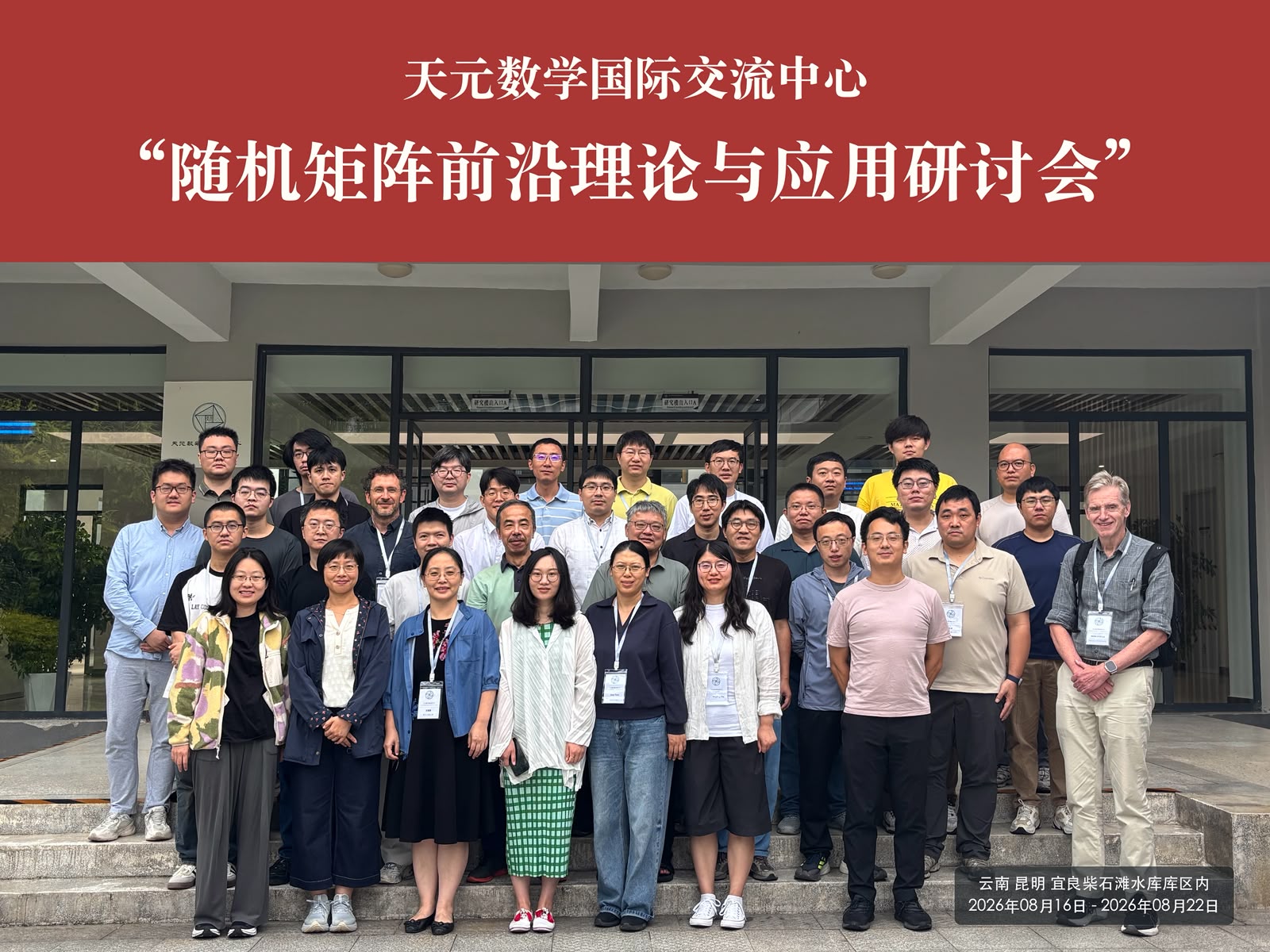
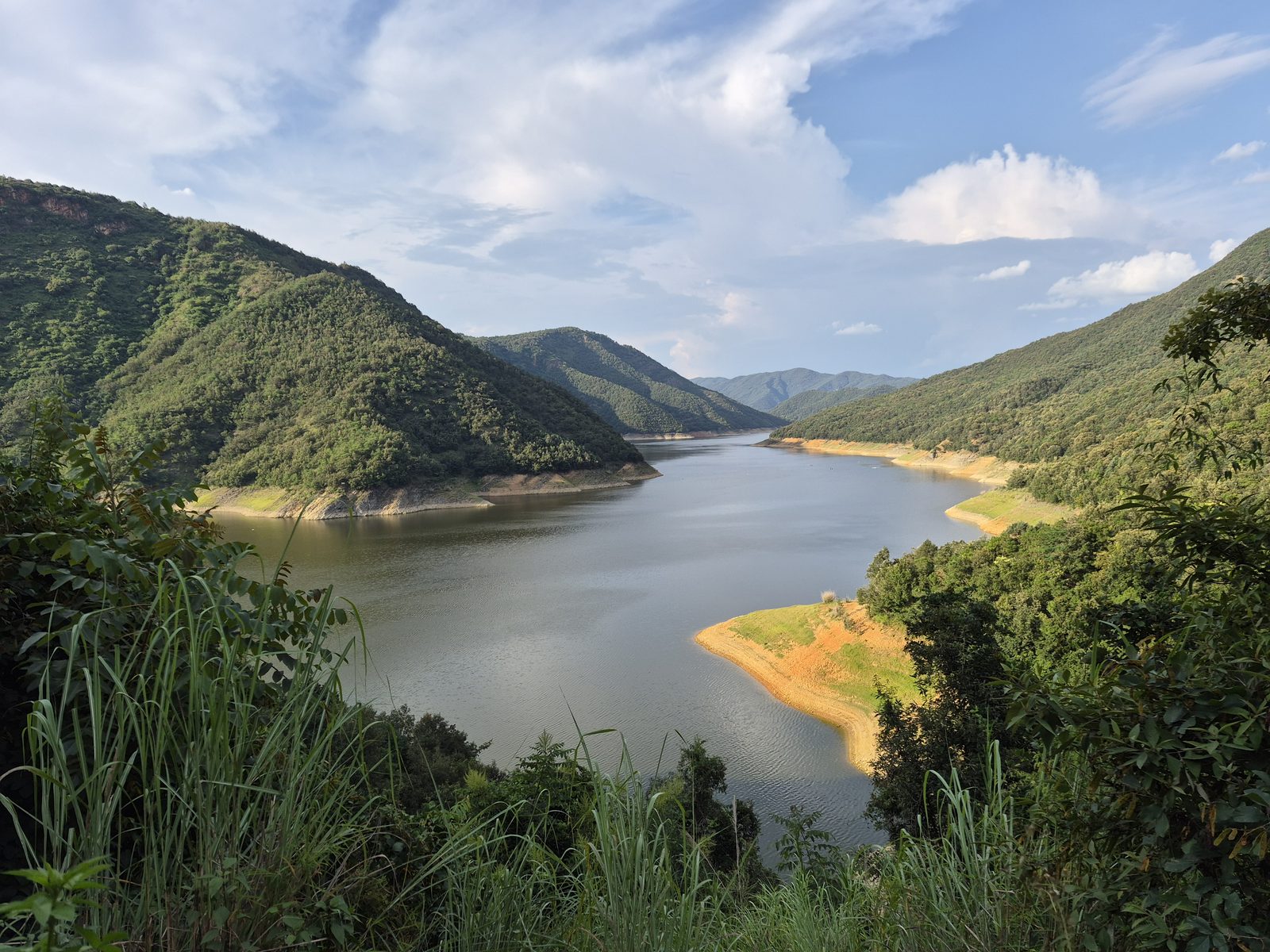
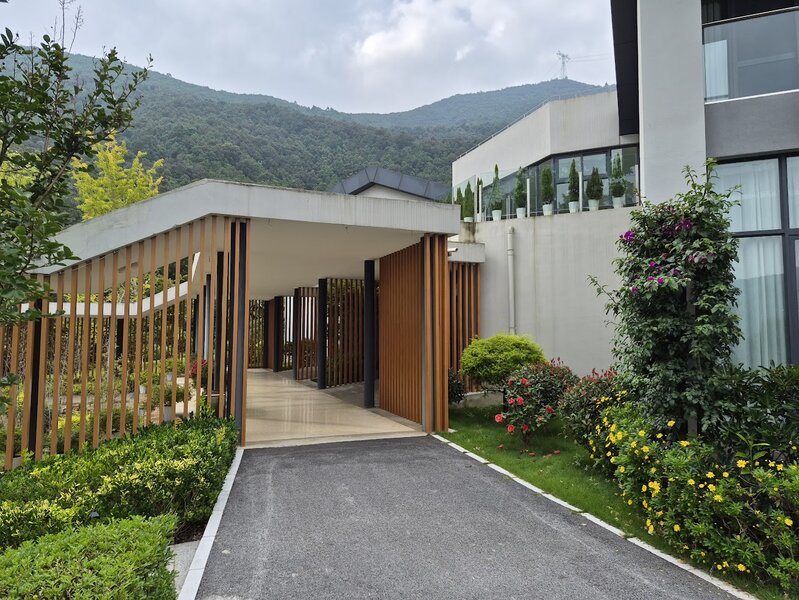
I have spent a week at the Tianyuan Mathematics Research Center (TYMC), near Kunming, Yunnan Province, China, attending a very enjoyable workshop on random matrix theory and its applications. This is one of the most impressive mathematical research facilities I have ever visited — a Chinese Oberwolfach. It opened only three years ago and lies in the heart of a forest.
This workshop was organized by the RMTA China research network, which also runs an online seminar. My connection with China/RMTA goes back to a summer school in Changchun in 2011, and a workshop in Hong Kong in 2015. It is also an opportunity to remember our colleague Wenbo Li (1963–2013), who participated in the Changchun summer school, and who left us far too soon.
During this workshop, it was obvious that 2026 is the year of mathematics in the age of AI. Many mathematicians are now using AI, for all aspects of their work, and it works better than ever. However, and especially for early- and mid-career mathematicians, this can be truly destabilizing and depressing. Nevertheless, our mathematical social system was already reaching absurdity, and thanks to the AI revolution, we are now forced to reinvent it. I like the idea that AI leads us to spend a larger proportion of time digesting mathematics, while keeping creativity in the way we question and imagine theorems. This is very much in the spirit of what I am used to doing, combining blog posts, research articles, and lecture notes. We may wonder if we can still list open problems in our talks and articles. In my view, the answer is positive, and we could keep open questions for ourselves and cook up public open questions for sharing with others. Given the efficiency of today AI for simultaneous translation of handwritten and spoken mathematics, I wonder what will be the effect in the near future for universities and foreign students. On a personal note, I realized that in 2026 I will have lived equally long in the twentieth and twenty-first centuries.
Back to Changchun and AI: the RMTA summer school, which can be seen as a pure mathematical event, was held at Northeast Normal University in Changchun. It turns out that Changchun is well known for its Institute of Optics, Fine Mechanics and Physics, which works on extreme ultraviolet lithography (EUV), a key technology for manufacturing leading-edge semiconductor chips, including GPUs. In the near future, Chinese firms may become serious competitors to ASML, the Dutch manufacturer of advanced lithography equipment and its European ecosystem.
Back to Hong Kong and AI: the RMTA workshop, which was a pure mathematical even, was held at the University of Hong Kong. It turns out that Hong Kong is adjacent to Shenzhen, often described as the Chinese Silicon Valley. More broadly, China already has a strong ecosystem for developing AI systems, including open-weight software models. Some Chinese open-weight models already perform strongly on mathematical benchmarks. How close will they come to the strongest American proprietary systems in research-level mathematics? This is unclear for the moment, according to Chinese colleagues who tried to convince Chinese companies to invest this idea.
Further reading.
- Terence Tao
Mathematics in the age of AI
Submitted to the Proceedings of the ICM 2026 - Djalil Chafaï
An optimal Poincaré inequality for the complex Ginibre log-gas
A personal and modest example of mathematics in the age of AI - 2026 - Collective
Proofs and Prompts - Notes from the common room
Collective blog started in 2026 - Maintained by Mustafa Y. Isik
What AI has actually contributed
A curated registry of scientific and mathematical results AI contributed to - LinuxFr
Aux origines du premier GPU, une bande de copains de l'ENS
August 16, 2026