| GPT-4 | March 2023 |
| GPT-4o | May 2024 |
| o1 (full version) first reasoning model | December 2024 |
| GPT-4.5 | February 2025 |
| GPT-5 | August 2025 |
| GPT-5.1 | November 2025 |
| GPT-5.2 | December 2025 |
| GPT-5.3-Codex | February 2026 |
| GPT-5.4 | March 2026 |
| Claude Sonnet 4.6 | February 2026 |
| GPT-5.5 | April 2026 |
| Claude Fable 5 | June 2026 |
| GPT-5.6 | July 2026 |
| Claude Opus 5 | July 2026 |
| GPT-6 Astra | September 2026 |
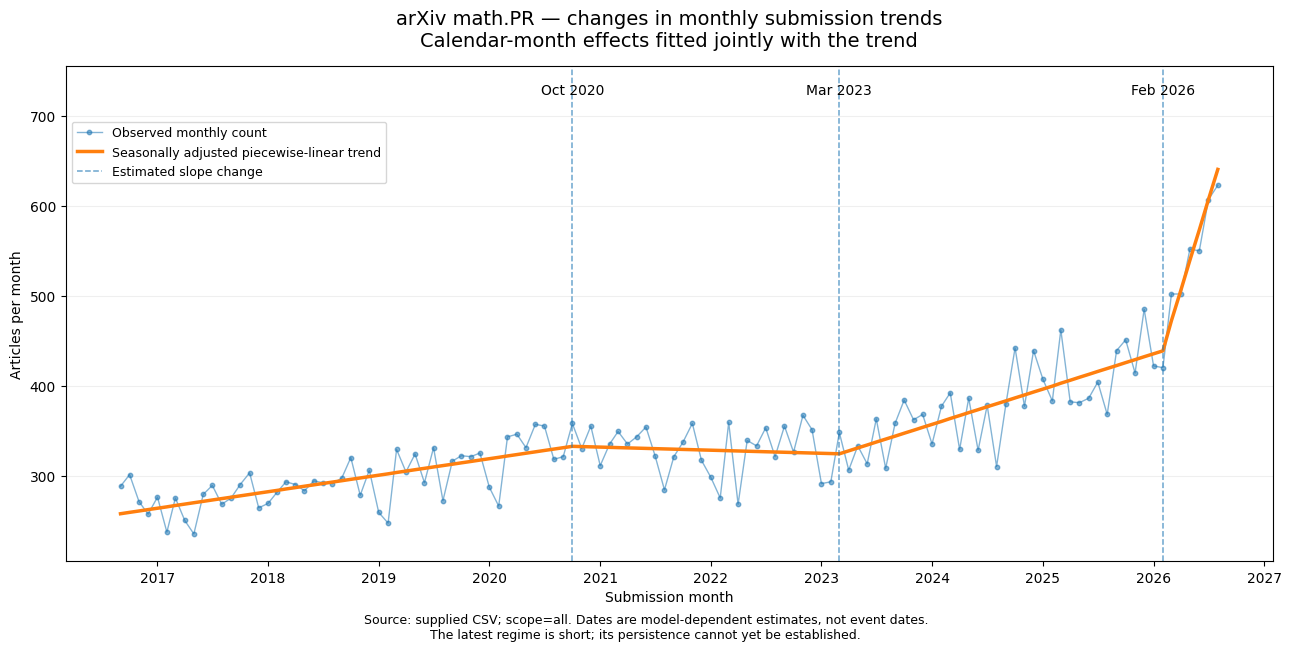
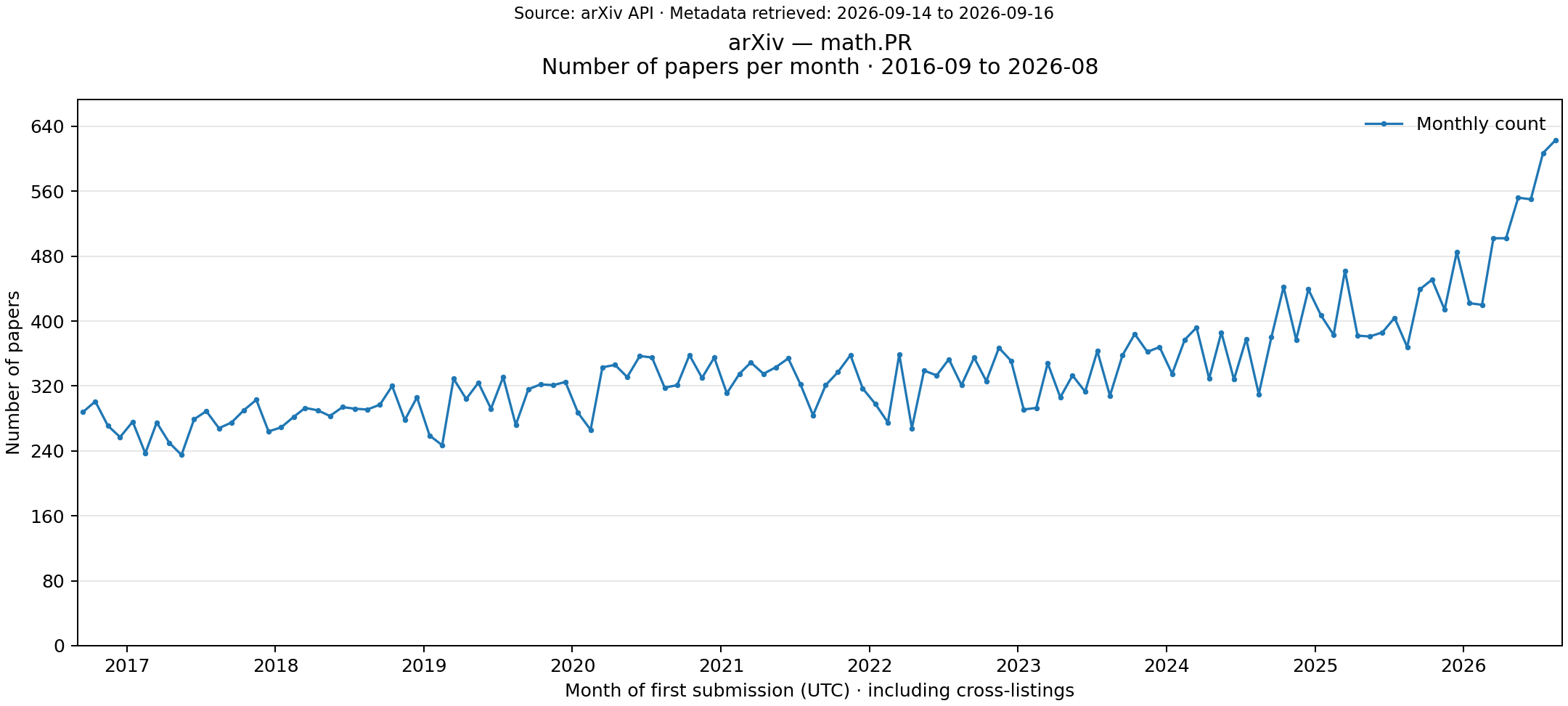
This post is about a natural question: we all feel a rise in the number of submissions on arXiv. But what is the quantitative reality, and what are the plausible conclusions? To explore this question, I have prompted ChatGPT to produce a gentle Python script to extract the monthly submissions to arXiv.math.PR, over the last ten years, using the arXiv API. This is more subtle than one can imagine. I have then prompted ChatGPT to produce the graphics and a time series analysis, keeping in mind a possible Covid effect and AI effect. What do we see? A global increase, with a long pause plausibly due to Covid, and a recent (2026) rise plausibly due to AI.
We bring together a descriptive analysis of monthly counts of articles classified under probability on arXiv, exploratory detection of trend changes, sensitivity checks, an examination of additional breaks over 2023–2026, and a discussion of possible explanations, including the Covid-19 pandemic and the rise of artificial intelligence. The analysis covers 120 consecutive months and 41 013 articles, including both primary and secondary classifications; the complete monthly counts are reproduced in Appendix A. The main model, a continuous piecewise-linear trend with monthly seasonal effects, selects breakpoints in October 2020, March 2023 and February 2026. These dates are not invariant across models: the most stable signal is a sharp acceleration in late 2025–early 2026, preceded by a slowdown and then a recovery whose dates are harder to pinpoint. Within the 2023–2026 window, an additional inflection in mid-2023 remains possible, whereas the segmentations of 2024–2025 are less stable. The aggregate series cannot attribute these developments to a particular cause or establish the persistence of the latest regime.
Further reading.
- ChatGPT prompted by the author of this blog
arXiv math.PR submissions : Trends, structural breaks and possible explanations
Analysis report - September 18, 2026 - Examples of documented or plausible AI effect on respected single authors
Example 1 Example 2 Example 3 Example 4
zbMATH covering arXiv preprints (September 2026) - arXiv.math.PR authors in 2026
The list sorted by number of papers submitted to arXiv.PR in 2026
arXiv.PR (September 2026)