Archive

Archive for December, 2011

Web to matrix Python module

December 28th, 2011 2 comments

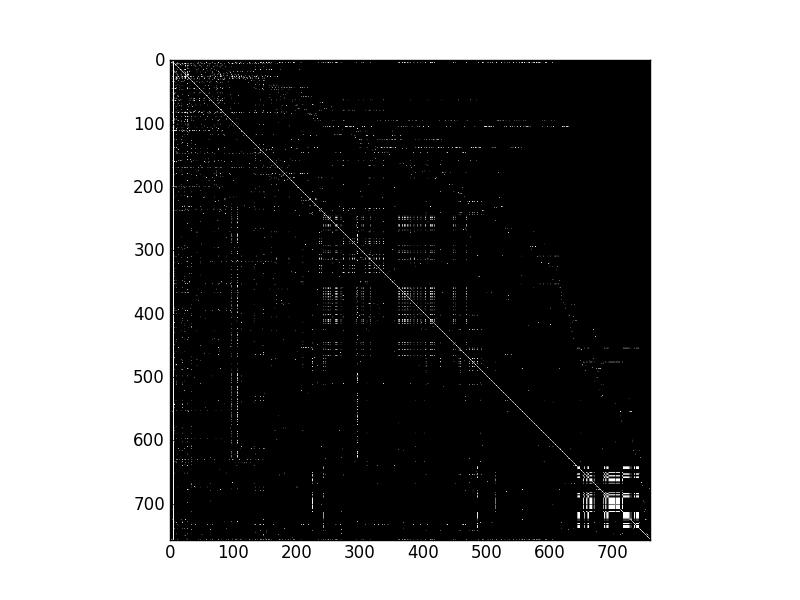
The beginning of winter is often the occasion to write programs. This year I wrote just for fun w2m.py, answering a question raised by my co-author Charles Bordenave. This Python 2.7 module+program consists in a spider which explores part of the World Wide Web, extracts the adjacency matrix, and computes its spectrum. Below the results for Wikipedia in Kabyle language. On the technical side, w2m.py has a simple object oriented code, which makes use of threading and numpy + matplotlib. I will hopefully convert it to Python 3.x some day (2to3).

Related: The University of Florida Sparse Matrix Collection (pointed out by Charles Bordenave).
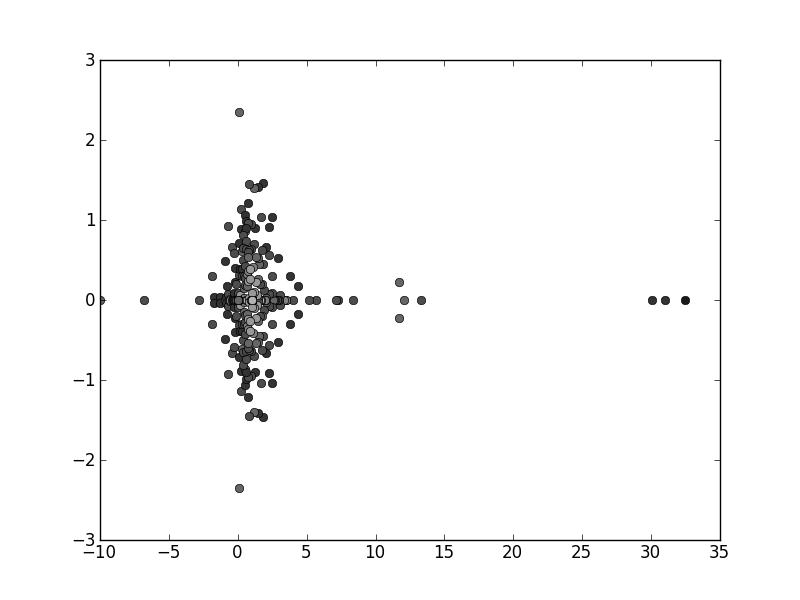


Adjacency matrix spectrum for Wikipedia in Kabyle language (2011-12-27)

Adjacency matrix spectrum for Wikipedia in Kabyle language (obtained in December 2011). The darkness of each point corresponds to the delocalization of the eigenvector.


Adjacency matrix of Wikipedia in Kabyle language (2011-12)

Adjacency matrix of Wikipedia in Kabyle language (obtained in December 2011)


Here is a chunk of the console output of w2m:

INFO:MainThread:_time_stamp():w2m.py 2011-12-28 12:27 http://kab.wikipedia.org/wiki
INFO:MainThread:work():please be patient, this may take some time
INFO:MainThread:work():urls=0(0,0) edges=0 vertices=0 threads=1
...
INFO:MainThread:work():urls=348(334,205) edges=3604 vertices=553 threads=20
...
INFO:MainThread:work():urls=743(713,0) edges=7544 vertices=743 threads=1
INFO:MainThread:_time_stamp():w2m.py 2011-12-28 12:30 http://kab.wikipedia.org/wiki
INFO:MainThread:show():number of accepted vertices: 743
INFO:MainThread:show():number of accepted edges: 7547
INFO:MainThread:show():number of explored vertices: 714
INFO:MainThread:show():number of http head errors: 6
INFO:MainThread:show():number of http get errors: 30
INFO:MainThread:show():number of analyzed urls: 744
INFO:MainThread:show():vertices coverage 96%.
INFO:MainThread:show():saving 'adjacency.jpg'
INFO:MainThread:show():computing eigenvalues and eigenvectors
INFO:MainThread:show():saving 'spectrum.jpg'
INFO:MainThread:show():saving 'octave.mat', use load('octave.mat') in octave
INFO:MainThread:show():saving 'vertices.lst'
INFO:MainThread:show():show() finished.
INFO:MainThread:_time_stamp():w2m.py 2011-12-28 12:30 http://kab.wikipedia.org/wiki
Categories: Graphs, IT, LinearAlgebra

Lorsqu’il n’y a pas d’étudiants dans la pièce…

December 21st, 2011 2 comments

Paul Lévy - Le mouvement brownien

… Imaginons maintenant un mathématicien du genre de Paul Lévy, qui écrirait comme les mathématiciens parlent entre eux lorsqu’il n’y a pas d’étudiants dans la pièce, et lancerait quantité d’idées nouvelles : je pense que ses travaux seraient refusés par la plupart des grands journaux mathématiques. C’est un peu inquiétant pour notre avenir. ” in L’originalité de P.  Lévy en mathématiques, Paul-André Meyer, La Jaune et la Rouge, novembre 1973. Read more on-line.

Integration by parts

December 14th, 2011 No comments

Niels Henrik Abel

It is amusing to realize how much the basic concept of integration by parts is fruitful in mathematics and in mathematical physics. Here are some instances:

The quality of these Wikipedia pages is not homogeneous. Feel free to improve them!

    The Hoffman-Wielandt inequality

    December 3rd, 2011 No comments

    Helmut Wielandt

    The Hoffman-Wielandt inequality is one of my favorite spectral inequalities in linear algebra. Before stating it, let us recall some basic concepts and objects.

    Normal matrices. A matrix \( {A\in\mathcal{M}_{n,n}(\mathbb{C})} \) is normal when \( {AA^*=A^*A} \), where \( {A^*} \) is its conjugate-transpose. This is equivalent to say that there exists a unitary matrix \( {U} \) such that \( {UAU^*} \) is diagonal (and the diagonal elements are precisely the eigenvalues of \( {A} \)). Every Hermitian and every unitary matrix is normal. A nilpotent matrix is never normal.

    Trace norm. The trace norm on \( {\mathcal{M}_{n,n}(\mathbb{C})} \) is defined for every \( {A\in\mathcal{M}_{n,n}(\mathbb{C})} \) by

    \[ \left\Vert A\right\Vert^2 :=\mathrm{Tr}(AA^*) =\mathrm{Tr}(A^*A) =\sum_{1\leq i,j\leq n} |A_{i,j}|^2. \]

    This norm is also known as the Frobenius norm, the Schur norm, or the Hilbert-Schmidt norm. As for the operator norm, the trace norm is unitary invariant, in the sense that \( {\left\Vert UAV\right\Vert=\left\Vert A\right\Vert} \) for any \( {n\times n} \) unitary matrices \( {U} \) and \( {V} \) and any \( {A\in\mathcal{M}_{n,n}(\mathbb{C})} \). The advantage of the trace norm over the operator norm lies in its convenient expression in terms of the matrix entries. Moreover, this norm is Hilbertian for the Hermitian product \( {\left<A,B\right>=\mathrm{Tr}(AB^*)} \).

    Hoffman-Wielandt inequality. It states that if \( {A,B\in\mathcal{M}_{n,n}(\mathbb{C})} \) are normal, with respective eigenvalues \( {\lambda_1(A),\ldots,\lambda_n(A)} \) and \( {\lambda_1(B),\ldots,\lambda_n(B)} \), then, denoting by \( {\Pi} \) the permutation group of \( {\{1,\ldots,n\}} \),

    \[ \min_{\pi\in\Pi}\sum_{i=1}^n(\lambda_i(A)-\lambda_{\pi(i)}(B))^2 \leq\left\Vert A-B\right\Vert^2. \]

    In other words, the optimal matching of the spectra of \( {A} \) and \( {B} \) beats the trace norm. Let us give a proof of the Hoffman-Wielandt inequality. We have

    \[ C:=UAU^*=\mathrm{diag}(\lambda_1(A),\ldots,\lambda_n(A)) \]

    and

    \[ D:=VBV^*=\mathrm{diag}(\lambda_1(B),\ldots,\lambda_n(B)) \]

    for some \( {n\times n} \) unitary matrices \( {U} \) and \( {V} \). By unitary invariance, we have

    \[ \left\Vert A-B\right\Vert^2 =\left\Vert U^*CU-V^*DV\right\Vert^2 =\left\Vert CUV^*-UV^*D\right\Vert^2 =\left\Vert CW-WD\right\Vert^2 \]

    where \( {W:=UV^*} \). This gives, denoting \( {P:=(|W_{i,j}|^2)_{1\leq i,j\leq n}} \),

    \[ \left\Vert A-B\right\Vert^2 =\sum_{i,j=1}^n((CW)_{i,j}-(WD)_{i,j})^2 =\sum_{i,j=1}^nP_{i,j}(\lambda_i(A)-\lambda_j(B))^2. \]

    The expression above is linear in \( {P} \). Moreover, since \( {W} \) is unitary, the matrix \( {P} \) is doubly stochastic. If \( {\mathcal{P}} \) is the set of \( {n\times n} \) doubly stochastic matrices then

    \[ \left\Vert A-B\right\Vert^2 \geq\inf_{Q\in\mathcal{P}}\Phi(Q) \quad\text{where}\quad \Phi(Q):=\sum_{i,j=1}^nQ_{i,j}(\lambda_i(A)-\lambda_j(B))^2. \]

    But \( {\Phi} \) is linear and \( {\mathcal{P}} \) is convex and compact, and thus the infimum above is achieved for some extremal point \( {Q} \) of \( {\mathcal{P}} \). Now a celebrated theorem due to Birkhoff and von Neumann states that the extremal points of \( {\mathcal{P}} \) are exactly the permutation matrices. Recall that \( {P\in\mathcal{P}} \) is a permutation matrix when for a permutation \( {\pi\in\Pi} \) where \( {\Pi} \) is the symmetric group, we have \( {P_{i,j}=\delta_{\pi(i),j}} \) for every \( {i,j\in\{1,\ldots,n\}} \). This gives the final step of the proof:

    \[ \left\Vert A-B\right\Vert^2 \geq \min_{\pi\in\Pi}\sum_{i=1}^n(\lambda_i(A)-\lambda_{\pi(i)}(B))^2. \]

    Coupling distance. Recall that the coupling distance between two probability measures \( {\eta_1,\eta_2} \) on \( {\mathbb{R}} \) with finite second moment is defined by

    \[ d(\eta_1,\eta_2):=\inf\sqrt{\mathbb{E}(|X_1-X_2|^2)} \]

    where the infimum runs over the set of couple of random variables \( {(X_1,X_2)} \) on \( {\mathbb{R}\times\mathbb{R}} \) with \( {X_1\sim\eta_1} \) and \( {X_2\sim\eta_2} \). In the case where \( {\eta_1=\frac{1}{n}\sum_{i=1}^n\delta_{a_i}} \) and \( {\eta_2=\frac{1}{n}\sum_{i=1}^n\delta_{b_i}} \) where \( {(a_i)_{1\leq i\leq n}} \) and \( {(b_i)_{1\leq i\leq n}} \) are sequences in \( {\mathbb{C}} \), we have, using the Birkhoff and von Neuman theorem on doubly stochastic matrices,

    \[ d(\eta_1,\eta_2)^2=\frac{1}{n}\min_{\pi\in\Pi}\sum_{i=1}^n(a_i-b_{\pi(i)})^2. \]

    This allows to rewrite the Hoffman-Wielandt inequality as

    \[ nd^2(\mu_A,\mu_B)\leq \left\Vert A-B\right\Vert^2 \]

    where

    \[ \mu_A:=\frac{1}{n}\sum_{i=1}^n\delta_{\lambda_i(A)} \quad\text{and}\quad \mu_B:=\frac{1}{n}\sum_{i=1}^n\delta_{\lambda_i(B)}. \]

    Note. Helmut Wielandt (1910 – 2001) devoted his doctoral thesis and habilitation to permutation groups. He has a book on finite permutation groups. From 1941 he did research on meteorology, cryptology and aerodynamics. In 1942 he was attached to the Kaiser Wilhelm Institute and the Aerodynamics Research Institute at Göttingen. He said “… I had to work on vibration problems. I am indebted to that time for valuable discoveries: on the one hand the applicability of abstract tools to the solution of concrete problems, on the other hand, the – for a pure mathematician – unexpected difficulty and unaccustomed responsibility of numerical evaluation. It was a matter of estimating eigenvalues of non-self-adjoint differential equations and matrices.” Source: MacTutor.

    Note. Alan Hoffman (1924 – ) is also famous for the Hoffman-Singleton graph.

    Categories: LinearAlgebra