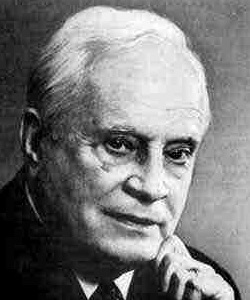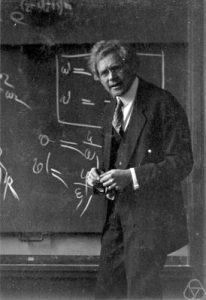
The set of non-negative harmonic functions is a convex cone, raising the question of integral representation using extreme rays, à la Krein-Milman/Choquet. This post is devoted to an interplay of this kind between complex analysis and convex geometry. More precisely, a theorem due to Gustav Herglotz (1881 - 1953) on the integral representation of holomorphic functions on the open unit disc with non-negative real part, and a theorem due to Rolf Herman Nevanlinna (1895 - 1980) on the integral representation of holomorphic functions on the open upper half-plane with non-negative imaginary part. In both cases, the set is a convex cone, and the integral representation involves extremal rays given by Möbius transforms. In what follows, we denote by
- $\mathbb{D}=\{z\in\mathbb{C}:|z| < 1\}$ the open unit disk
- $\mathbb{T}=\{z\in\mathbb{C}:|z|=1\}$ the unit circle or one-dimensional torus
- $\mathbb{C}_+=\{z\in\mathbb{C}:\Im z > 0\}$ the open upper half plane.
Herglotz theorem. For all $F:\mathbb{D}\to\mathbb{C}$, the following two properties are equivalent:
- $F$ is holomorphic and $\Re F\geq 0$
- $F$ admits an integral representation of the form \[ F(z)= \mathrm{i}\beta + \int\frac{\zeta+z}{\zeta-z}\mathrm{d}\nu(\zeta),\quad z\in\mathbb{D}, \] where $\beta\in\mathbb{R}$ and $\nu$ is a finite positive Borel measure on $\mathbb{T}$ (possibly $=0$).
Since $\nu(\mathbb{T})=\Re F(0)$, we have $\nu=0$ iff $\Re F(0)=0$.
The theorem gives an integral formula for the non-negative harmonic function $\Re F$.
Geometrically, the set of holomorphic $F:\mathbb{D}\to\mathbb{C}$ such that $\Re F\geq0$ is stable by linear combinations with non-negative coefficients (a convex cone). The Herglotz theorem shows that it contains the one-dimensional linear space $f=\mathrm{i}\beta$, $\beta\in\mathbb{R}$. For this reason, it has no extremal points since $f=f-\mathrm{i}\beta+\mathrm{i}\beta$. However, for $\beta=0$, the extreme rays are the Möbius transforms $z\mapsto C\frac{c+z}{c-z}$, $c\in\mathbb{T}$, $C > 0$, which correspond to $\nu=C\delta_c$.
Proof. $\Uparrow$. If $F$ admits an integral representation $(\beta,\nu)$, then for all $z\in\mathbb{D}$, \[ \Re F(z)=\int\frac{1-|z|^2}{|\zeta-z|^2}\mathrm{d}\nu(\zeta)\geq0. \] Since the function under the integral is $ > 0$, this also shows that if $\Re F(z)=0$ for some $z\in\mathbb{D}$, then $\nu=0$ and therefore $\Re F(z)=0$ for all $z\in\mathbb{D}$. This observation suggests an alternative "strict" version of the theorem where $\Re F > 0$ and $\nu\neq0$.
Next, $|\zeta|=1$ and $|z| < 1$, hence $|\zeta-z|\geq 1-|z|$, and $\frac{|\zeta+z|}{|\zeta-z|}\leq\frac{1+|z|}{1-|z|}=C_z < \infty$, thus $\int\frac{\zeta+z}{\zeta-z}\mathrm{d}\nu(\zeta)$ is absolutely convergent, and $F$ is holomorphic by dominated convergence.
$\Downarrow$. Let $F:\mathbb{D}\to\mathbb{C}$ be holomorphic with $\Re F\geq0$. The first step is to extract the boundary measure $\nu$. Let $u=\Re F$. Since $u\geq0$ is continuous, for all $0 < r<1$, \[ \mathrm{d}\nu_r(\mathrm{e}^{\mathrm{i}\theta}) := u(r\mathrm{e}^{\mathrm{i}\theta})\frac{\mathrm{d}\theta}{2\pi} \] is a positive Borel measure on $\mathbb{T}$. By the mean-value property for the harmonic function $u$, \[ \nu_r(\mathbb{T})=\int_{0}^{2\pi}u(r\mathrm{e}^{\mathrm{i}\theta})\frac{\mathrm{d}\theta}{2\pi}=u(0)=\Re F(0). \] If $\Re F(0)=0$ then $\nu_r=0\to0$ as $r\to1$, and we set $\nu=0$. If $\Re F(0) > 0$, then since $\mathbb{T}$ is compact, ${(\nu_r)}_{0 < r<1}$ is tight, and by the Prohorov theorem, there exists a sequence $r_n\to1$ in $(0,1)$ and a positive Borel measure $\nu$ on $\mathbb{T}$ such that $\nu(\mathbb{T})=\Re F(0)$ and $\nu_{r_n}\to\nu$ narrowly.
Fix $z\in\mathbb D$. For $n$ large enough, we have $|z| < r_n$ and the Poisson representation of the harmonic function $u$ on $r_n\mathbb{D}$ yields \[ u(z)=\int P_{\frac{z}{r_n}}(\zeta)\mathrm{d}\nu_{r_n}(\zeta) \quad\text{where}\quad P_w(\zeta)=\frac{1-|w|^2}{|\zeta-w|^2},\quad \zeta\in\mathbb{T}. \] Since $P_w$ is continuous on the compact set $\mathbb{T}$, it is bounded. Since $P_{z/r_n}\to P_z$ uniformly and since $\nu_{r_n}\to\nu$ narrowly, it follows that \[ u(z)=\int P_z(\zeta)\mathrm{d}\nu(\zeta). \] Now, a natural holomorphic $G:\mathbb{D}\to\mathbb{C}$ such that $\Re G=u$ is \[ G(z):=\int\frac{\zeta+z}{\zeta-z}\mathrm{d}\nu(\zeta). \] Indeed, as we have already seen, the integrand is bounded on $\mathbb{T}$, $G$ is well defined, its holomorphicity follows from the one of the integrand and dominated convergence on compact subsets of $\mathbb{D}$, and $\Re G=u$. It remains to compare $F$ and $G$. Since $F-G$ is holomorphic on $\mathbb{D}$ and $\Re(F-G)=0$ on $\mathbb{D}$, by the Cauchy-Riemann equations, $\nabla\Im(F-G)=0$ on $\mathbb{D}$, hence $\Im(F-G)$ is constant, in other words $F-G=\mathrm{i}\beta$ for some $\beta\in\mathbb{R}$.
Uniqueness. We have $\beta=\Im F(0)$. Let us show that $\nu$ is unique by using Fourier coefficients. Namely, suppose that $(\beta,\nu_1)$ and $(\beta,\nu_2)$ represent $F$. From the proof above, \[ 0=\Re\int\frac{\zeta+z}{\zeta-z}\mathrm{d}(\nu_1-\nu_2)(\zeta) =\int P_z(\zeta)\mathrm{d}(\nu_1-\nu_2)(\zeta). \] By writing $z=r\mathrm{e}^{\mathrm{i}\theta}$, $0 < r<1$, $\zeta=\mathrm{e}^{\mathrm{i}t}$, and using $P_z(\zeta)=P_r(\mathrm{e}^{-\mathrm{i}\theta}\zeta)=P_r(\mathrm{e}^{\mathrm{i}(t-\theta)})$ and $P_r(\mathrm{e}^{\mathrm{i}s})=\frac{1-r^2}{1-2r\cos(s)+r^2}=\sum_{n\in\mathbb{Z}}r^{|n|}\mathrm{e}^{\mathrm{i}ns}$, we get $\widehat{\nu_1-\nu_2}=0$ for all $n\in\mathbb{Z}$, hence $\nu_1=\nu_2$.
Herglotz transform and its inversion formula. The Herglotz transform $H_\mu:\mathbb{D}\to\mathbb{C}$ of a probability measure $\mu$ on $\mathbb{T}$ is defined by \[ H_\mu(z)=\int_{\mathbb{T}}\frac{\zeta+z}{\zeta-z}\mathrm{d}\mu(\zeta),\quad |z| < 1. \] Then from what precedes, $\Re H_\mu(z)=\int_{\mathbb{T}}\frac{1-|z|^2}{|\zeta-z|^2}\mathrm{d}\mu(\zeta)$, and the inversion formula is \[ \frac{1}{2\pi}\Re H_\mu(r\mathrm{e}^{\mathrm{i}t})\mathrm{d}t \xrightarrow[r\nearrow1]{\mathrm{narrow}} \mu. \] If $\mu=\mu_{\mathrm{ac}}+\mu_{\mathrm{sing}}$ is the decomposition into absolutely continuous and singular parts, then \[ \mu_{\mathrm{ac}}(\mathrm{e}^{\mathrm{i}t})=\frac{1}{2\pi}\lim_{r\nearrow1}\Re H_\mu(r\mathrm{e}^{\mathrm{i}t}) \] while for the atoms \[ \mu(\{\mathrm{e}^{\mathrm{i}t_0}\}) =\lim_{r\nearrow1}\frac{1-r}{2}H_\mu(r\mathrm{e}^{\mathrm{i}t_0}) =\lim_{r\nearrow1}\frac{1-r}{2}\Re H_\mu(r\mathrm{e}^{\mathrm{i}t_0}). \]
Nevanlinna theorem. For all $f:\mathbb{C}_+\to\mathbb{C}$, the following properties are equivalent:
- $f$ is holomorphic and $\Im f\geq0$.
- $f$ admits an integral representation of the form \[ f(z)=az+b+\int\Bigl(\frac{1}{\lambda-z}-\frac{\lambda}{1+\lambda^2}\Bigr)\mathrm{d}\mu(\lambda) =az+b+\int\frac{1+\lambda z}{\lambda-z}\frac{\mathrm{d}\mu(\lambda)}{1+\lambda^2}, \quad z\in\mathbb{C}_+, \] where $a,b\in\mathbb{R}$, $a\geq0$, and $\mu$ is a positive Borel measure on $\mathbb{R}$ satisfying \[ \int_{\mathbb{R}}\frac{\mathrm{d}\mu(\lambda)}{1+\lambda^2} < \infty. \]
The theorem gives an integral formula for the non-negative harmonic function $\Im f$.
Geometrically, the set of holomorphic $f:\mathbb{C}_+\to\mathbb{C}$ such that $\Im f\geq0$ is stable by linear combinations with non-negative coefficients (convex cone). The Nevanlinna theorem shows that this cone contains the line of constant real functions, which corresponds to $b\in\mathbb{R}$ in the integral representation. For this reason it has no extremal points since $f=f-b+b$. However, if we fix $b=0$, the extreme rays are given by $f(z)=az$, $a > 0$, for which $\mu=0$, and the Möbius transforms $f(z)=\frac{C}{1+c^2}\frac{1+cz}{c-z}$, for which $a=0$ and $\mu=C\delta_c$.
The term $\int\frac{\mathrm{d}\mu(\lambda)}{\lambda-z}$ is the Cauchy-Stieltjes transform of $\mu$ at point $z$. The term $\int\frac{\lambda\mathrm{d}\mu(\lambda)}{1+\lambda^2}$ is a correction to get a convergent integral, in other words to remove the singularity due to the possible lack of integrability of $1/\lambda$ for $\mu$ at infinity. More precisely, as $\lambda\to\infty$, \[ \frac{1}{\lambda-z}-\frac{\lambda}{1+\lambda^2} =\Bigl(\frac{1}{\lambda}+\frac{z}{\lambda^2}+O\Bigl(\frac{1}{\lambda^3}\Bigr)\Bigr) -\Bigl(\frac{1}{\lambda}-\frac{1}{\lambda^3}+O\Bigl(\frac{1}{\lambda^5}\Bigr)\Bigr) =\frac{z}{\lambda^2}+O\Bigl(\frac{1}{\lambda^3}\Bigr). \] When $\mu$ is finite : $\mu(\mathbb{R}) < \infty$, then the bound $1/|\lambda -z|\leq1/|\Im z|$ implies that the Cauchy-Stieltjes transform of $\mu$ is finite, and the correction is useless.
Proof. $\Uparrow$. Let $f:\mathbb{C}_+\to\mathbb{C}$ with integral representation $(a,b,\mu)$. Then for all $z\in\mathbb{C}_+$, \[ \Im f(z) =a\Im z+\Im z\int\frac{\mathrm{d}\mu(\lambda)}{|\lambda -z|^2}\geq0. \] Moreover, for all $z\in\mathbb{C}_+$, the function $t\in\mathbb{R}\mapsto\bigl|\frac{1+t z}{(t-z)}\bigr|$ is continuous and tends to $|z|$ as $|t|\to\infty$, hence it is bounded by some constant $C_z$, and the integral with respect to $\mathrm{d}\mu(t)$ converges absolutely as soon as $1/(1+t^2)\in L^1(\mu)$. The holomorphicity with respect to $z$ of this integral follows from dominated convergence on compact subsets of $\mathbb C_+$.
$\Downarrow$. Let $f:\mathbb{C}_+\to\mathbb{C}$ be holomorphic with $\Im f\geq0$. We proceed by reducing to the disk case (Herglotz theorem). We introduce the Cayley transform $\phi:\mathbb D\to\mathbb C_+$ and its inverse \[ \phi(w)= \mathrm{i}\frac{1+w}{1-w},\quad \phi^{-1}(z)=\frac{z-\mathrm{i}}{z+\mathrm{i}}. \] The function $F:= -\mathrm{i}(f\circ\phi)$ is holomorphic on $\mathbb{D}$ and $\Re F=\Im(f\circ\phi)\geq 0$. By the Herglotz theorem, there exist $\beta\in\mathbb{R}$ and a finite positive Borel measure $\nu$ on $\mathbb{T}$ (possibly $\nu=0$) such that \[ F(w)=\mathrm{i}\beta +\int\frac{\zeta+w}{\zeta-w}\mathrm{d}\nu(\zeta),\quad w\in\mathbb{D}. \] By composing with $\phi^{-1}$ we get, for all $z\in\mathbb{C}_+$, \[ f(z)=\mathrm{i}F(\phi^{-1}(z))=-\beta +\mathrm{i}\int\frac{\zeta+w}{\zeta-w}\mathrm{d}\nu(\zeta), \quad w=\frac{z-i}{z+i}. \] At this step, we decompose $\nu$ into its atom at $\zeta=1$ and the remainder, namely \[ \nu = a\delta_1+\nu_0,\quad a:=\nu(\{1\})\geq 0,\quad \nu_0(\{1\})=0. \] Since $z=\mathrm{i}\frac{1+w}{1-w}$, we get $\frac{1+w}{1-w} = -\mathrm{i}z$, hence $\mathrm{i}a\frac{1+w}{1-w}=az$, and therefore \[ f(z) = a z -\beta + \mathrm{i}\int\frac{\zeta+w}{\zeta-w}\mathrm{d}\nu_0(\zeta). \] Let $\widetilde{\nu}$ be the image of $\nu_0$ by $\zeta\in\mathbb{T}\setminus\{1\}\mapsto t=\mathrm{i}\frac{1+\zeta}{1-\zeta}\in\mathbb{R}$. We have $\mathrm{i}\frac{\zeta+w}{\zeta-w} = \frac{1+tz}{t-z}$, and thus \[ f(z)= a z -\beta + \int\frac{1+tz}{t-z}\mathrm{d}\widetilde{\nu}(t). \] Note that $\widetilde{\nu}(\mathbb{R})=\nu_0(\mathbb{T})=\nu(\mathbb{T})-a < \infty$. It remains to take $\mathrm{d}\mu(t):=(1+t^2)\mathrm{d}\widetilde\nu(t)$ since \[ \frac{1+t z}{t-z}=(1+t^2)\Bigl(\frac{1}{t-z}-\frac{t}{1+t^2}\Bigr). \]
Uniqueness. Moreover the triple $(a,b,\mu)$ is unique since \[ a=\lim_{y\to\infty}\frac{f(\mathrm{i}y)}{\mathrm{i}y},\quad b=\Re f(\mathrm{i}), \] and we can recover $\mu$ from the behavior of $\Im f$ near $\mathbb{R}$ by Poisson-Stieltjes inversion on \[ \Im f(x+\mathrm{i}y)=ay+\int\frac{y}{(t-x)^2+y^2}\mathrm{d}\mu(t). \] Alternatively, we could use the uniqueness of $\nu$ in the Herglotz theorem.
Note. Herglotz/Nevanlinna functions were actually also studied by Thomas-Joannes Stieltjes (1856 - 1894), Georg Alexander Pick (1859 - 1942), Constantin Carathéodory (1873 - 1950), and many others. There are important ramifications and contemporary resonances in operator algebras, free probability theory, and random matrix theory.
Further reading.
- Jim Agler, John E. McCarthy, Nicholas J. Young
Operator Analysis: Hilbert Space Methods in Complex Analysis
Cambridge University Press (2020)