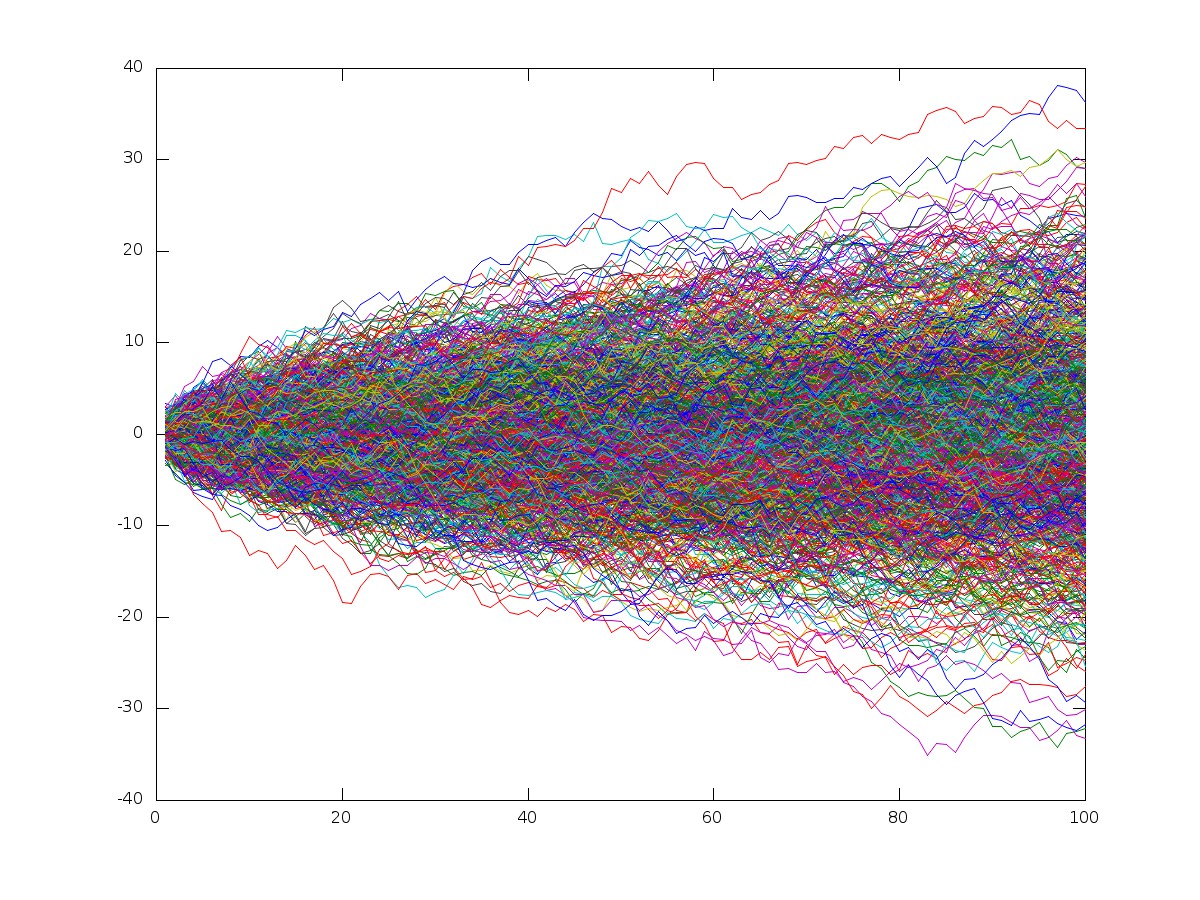
Yesterday, a colleague of mine asked during a dinner ``is there an elementary way to construct martingales which are not Markov chains?'' Let us show that the answer is positive, by using a recursive recipe. Let \( {{(f_n)}_{n\geq1}} \) be a sequence of functions where \( {f_{n+1}:\mathbb{R}^{n+1}\rightarrow\mathbb{R}} \). Let \( {{(\varepsilon_n)}_{n\geq1}} \) be a sequence of i.i.d. real random variables of zero mean, independent of a real random variable \( {X_0} \). We now define the sequence \( {{(X_n)}_{n\geq0}} \) by setting, for every \( {n\geq0} \),
\[ X_{n+1}:=f_{n+1}(X_0,\ldots,X_n,\varepsilon_{n+1}). \]
We may safely assume that our ingredients \( {X_0} \), \( {{(f_n)}_{n\geq1}} \), and \( {{(\varepsilon_n)}_{n\geq1}} \) are chosen in such a way that \( {X_n} \) is integrable for every \( {n\geq0} \). The stochastic process \( {{(X_n)}_{n\geq0}} \) is a martingale for its natural filtration as soon as for every \( {n\geq0} \) and \( {x_0,\ldots,x_n\in\mathbb{R}} \),
\[ \mathbb{E}(f_{n+1}(x_0,\ldots,x_n,\varepsilon_{n+1}))=x_n. \]
However, if for instance \( {f_{n+1}} \) depends on the first variable \( {x_0} \) for every \( {n\geq0} \) then \( {{(X_n)}_{n\geq0}} \) is not a Markov chain (of any order). This is clearly the case if we take
\[ f_{n+1}(x_0,\ldots,x_n,\varepsilon) =\varepsilon g_{n+1}(x_0,\ldots,x_n)+x_n \]
where \( {g_{n+1}:\mathbb{R}^{n+1}\rightarrow\mathbb{R}} \) depends on its first variable for every \( {n\geq0} \). This leads to the following simple example of a martingale which is not a Markov chain (of any order):
\[ X_{n+1}=\varepsilon_{n+1}X_0+X_n. \]
Another way to construct martingales which are not Markov chains (of any order) consists in perturbing a martingale. Namely, let \( {{(M_n)}_{n\geq0}} \) be a martingale for some filtration, and let \( {(X_n)_{n\geq0}} \) be a martingale constructed as above, using ingredients \( {X_0} \) and \( {{(\varepsilon_n)}_{n\geq1}} \) independent of \( {(M_n)_{n\geq0}} \). Then one may define the sequence \( {{(Y_n)}_{n\geq0}} \) by \( {Y_n=M_n+X_n} \). The stochastic process \( {{(Y_n)}_{n\geq0}} \) is a martingale (one can guess the filtration!), but is not a Markov chain (of any order) if \( {g_{n+1}} \) depends on the first variable.
Note. A Markov chain (of any order) is a stochastic recursive sequence of finite order, or equivalently an auto-regressive process of finite order (possibly nonlinear). In contrast, the martingale property does not put constraints on the order of recursion, while imposing a linear projection condition. If \( {{(M_n)}_{n\geq0}} \) and \( {{(M_n')}_{n\geq0}} \) are two martingales for the same filtration then \( {{(M_n+M_n')}_{n\geq0}} \) is a martingale. In contrast, the sum of two Markov chains is not a Markov chain in general, and various counter examples are available. Here is an elementary counter example provided by my friend Arnaud Guyader: if for all \( {n\geq0} \) we set \( {X_n=X} \) and \( {Y_n=(-1)^nX} \) for some arbitrary random variable \( {X} \) not identically zero, then \( {S_n=X_n+Y_n=2X\mathbf{1}_{\{n\text{ even}\}}} \) does not define a Markov chain.
Converse. The converse is well known. Namely, if \( {{(M_n)}_{n\geq0}} \) is a Markov chain with state space \( {E} \) and kernel \( {P} \), and if \( {f:E\rightarrow\mathbb{R}} \) is such that \( {f(M_n)} \) is integrable for every \( {n\geq0} \), then \( {{(f(M_n))}_{n\geq0}} \) is a martingale as soon as \( {f} \) is harmonic, i.e. \( {Pf=f} \). In particular, if \( {E=\mathbb{R}} \) then \( {{(M_n)}_{n\geq0}} \) is a martingale as soon as \( {P(x,\cdot)} \) has mean \( {x} \) for every \( {x} \).
What is the law of the process you plotted some trajectories of ? Is that a random walk ?
Yes, Gaussian random walk. In Octave: plot(cumsum(randn(100,1000))).
Nice,
I have to keep that example in mind,
thanks
Dear Professor,
The post is very interesting. I have a problem on the construction of the Martingales which are not a Markov chain by perturbing a given martingale. I do not know why the function $g_{n+1}$ turns to be $g_{n}$, when checking the martingale property of $Y_{n+1}$. Can you give an explaination for me? Thank you very much!
Yours Sincerely,
guangyu
Yes, it was a typo. Thanks. This is fixed now I think. Best.
Yea, thank you very much~
Best regards.@Djalil Chafaï
Although it has been a long time, I would like to ask a question in case someone is still watching this webiste.
When we define X_{n+1} := X_n + \epsilon_{n+1}X_0 we are told that the \epsilon_n's are independent of X_0.
I assume that the filtration is the one generated by F_n=\sigma(X_0, X_1, ... , X_n).
Hence when we try to prove that it is a martingale, we use the fact that
E[X_{n+1}|F_n] = X_n + E[\epsilon_{n+1}X_0 |F_n] = X_n +X_0E[\epsilon_{n+1}|F_n]
And this is my question:
How do we know that \epsilon_{n+1} is independent of F_n if we were only told that the epsilon_n's are independent of X_0 only?
Best Regards,
Maurizio
Dear Maurizio, $\mathcal{F}_n$ is generated by $X_0$, $\varepsilon_1,\ldots,\varepsilon_n$, so it is independent of $\varepsilon_{n+1}$, because the random variables $X_0,\varepsilon_1,\ldots$ are all independent..
Is it possible to have the MATLAB code you used to plot the graph? Thank you.
Great article on the martingale property and how it doesn't constrain recursion the way most traders think - that's exactly why I kept blowing accounts chasing single-EA solutions that worked in one regime but destroyed my drawdown in another. I've been testing Ratio X Toolbox on MT5, and the whole point is having separate bots for trending vs ranging vs breakout conditions, which actually aligns with what you're describing about not forcing one mathematical model onto all market scenarios. Has anyone else here moved away from the "one EA to rule them all" approach?